Friday, September 11, 2026
|
|
|
|
There are many remarkable pieces of writing about 9/11. I am sure you’ve come across many this week, and that you’ll come across many more this weekend. There is a good chance you’ve come across this one—"The Falling Man" by Tom Junod—before. Written in 2003, it is an exquisite, intimate tether to the horrors of that day. I steal a few moments each year to read it. You can do the same below. —Madison Vain, executive editor
|
|
|
|
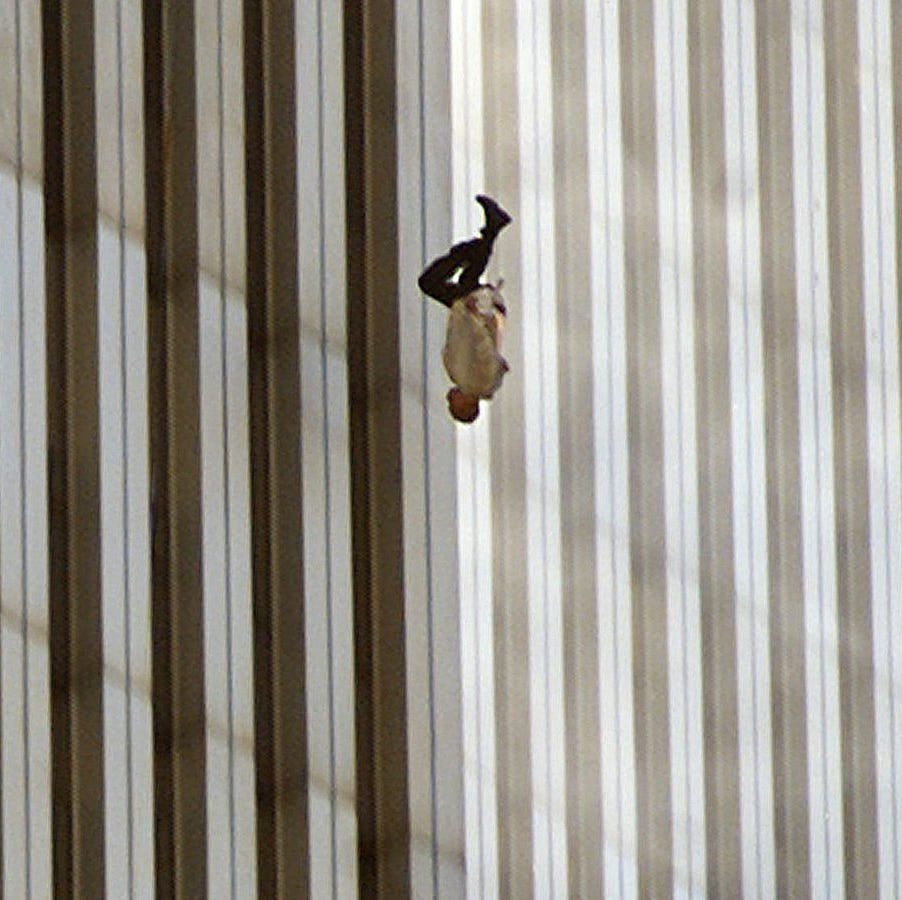
Do you remember this photograph? In the United States, people have taken pains to banish it from the record of September 11, 2001. The story behind it, though, and the search for the man pictured in it, are our most intimate connection to the horror of that day.
|
In the picture, he departs from this earth like an arrow. Although he has not chosen his fate, he appears to have, in his last instants of life, embraced it. If he were not falling, he might very well be flying.
He appears relaxed, hurtling through the air. He appears comfortable in the grip of unimaginable motion. He does not appear intimidated by gravity's divine suction or by what awaits him. His arms are by his side, only slightly outriggered. His left leg is bent at the knee, almost casually. His white shirt, or jacket, or frock, is billowing free of his black pants. His black high-tops are still on his feet. In all the other pictures, the people who did what he did—who jumped—appear to be struggling against horrific discrepancies of scale. They are made puny by the backdrop of the towers, which loom like colossi, and then by the event itself. Some of them are shirtless; their shoes fly off as they flail and fall; they look confused, as though trying to swim down the side of a mountain. The man in the picture, by contrast, is perfectly vertical, and so is in accord with the lines of the buildings behind him. He splits them, bisects them: Everything to the left of him in the picture is the North Tower; everything to the right, the South. Though oblivious to the geometric balance he has achieved, he is the essential element in the creation of a new flag, a banner composed entirely of steel bars shining in the sun. Some people who look at the picture see stoicism, willpower, a portrait of resignation; others see something else—something discordant and therefore terrible: freedom.
There is something almost rebellious in the man's posture, as though once faced with the inevitability of death, he decided to get on with it; as though he were a missile, a spear, bent on attaining his own end. He is, fifteen seconds past 9:41 a.m. EST, the moment the picture is taken, in the clutches of pure physics, accelerating at a rate of thirty-two feet per second squared. He will soon be traveling at upwards of 150 miles per hour, and he is upside down. In the picture, he is frozen; in his life outside the frame, he drops and keeps dropping until he disappears.
|
|
|
|
The US Open has never been short on star power. Every year, New York's Arthur Ashe Stadium attracts the biggest names in tennis, along with the celebrities, athletes, and style obsessives who come to watch them. And, naturally, where there are big names, there are big watches.
For Rolex, the US Open is an especially fitting showcase. The brand has been intertwined with tennis for almost half a century, supporting the sport's biggest tournaments and its most accomplished players. This year, that means plenty to look at on the wrists of the game's biggest names.
Leading the charge is Carlos Alcaraz, who arrived in New York as defending champion wearing one seriously impressive Daytona. The Spaniard, who was knocked out of the competition in yesterday’s quarter-finals, was spotted sporting Rolex's yellow-gold Cosmograph Daytona “Le Mans,” one of the most sought-after versions of the racing chronograph.
|
|
|
|
I'm a uniform dresser. That’s my life. I used to fight it because I didn’t want to concede to dressing like every other kid in my Georgia town. But growing up for me was realizing there’s nothing wrong with regressing, nothing wrong with dressing like your dad. Just because I wear the same boots, same jeans, same polo every day doesn’t mean I’m adopting a Steve Jobs 100 of the same black turtleneck asceticism, nor does it mean I look like I’m on the SEC fraternity guy to Sea Island dad pipeline. Instead, it means that I’ve developed blind loyalty for the brands that fit said uniform.
The cowboy boots are Lucchese. The jeans are Wrangler. The jean jacket is RRL. The polos are Lacoste. But the polos found a challenger when Hanover came across my desk. The brand’s raison d’être—to “make everyday essentials ... produced in Los Angeles with nothing priced over $300”—piqued my interest. But what got me really interested was seeing that the piqué polo is only $110, exactly on par with the two big-name brands with recognizable horse or crocodile left chest logos. And once I held the shirt, wore it, I was sold.
You might only be able to get them in a few colors right now, but this is a polo that is miles ahead of the big names. This is a polo that’s made for uniform dressing.
|
|
|
|
|









No comments:
Post a Comment